IQ Score Ranges Explained
 Scores
Last updated: September 1, 2026
What do IQ score ranges mean?
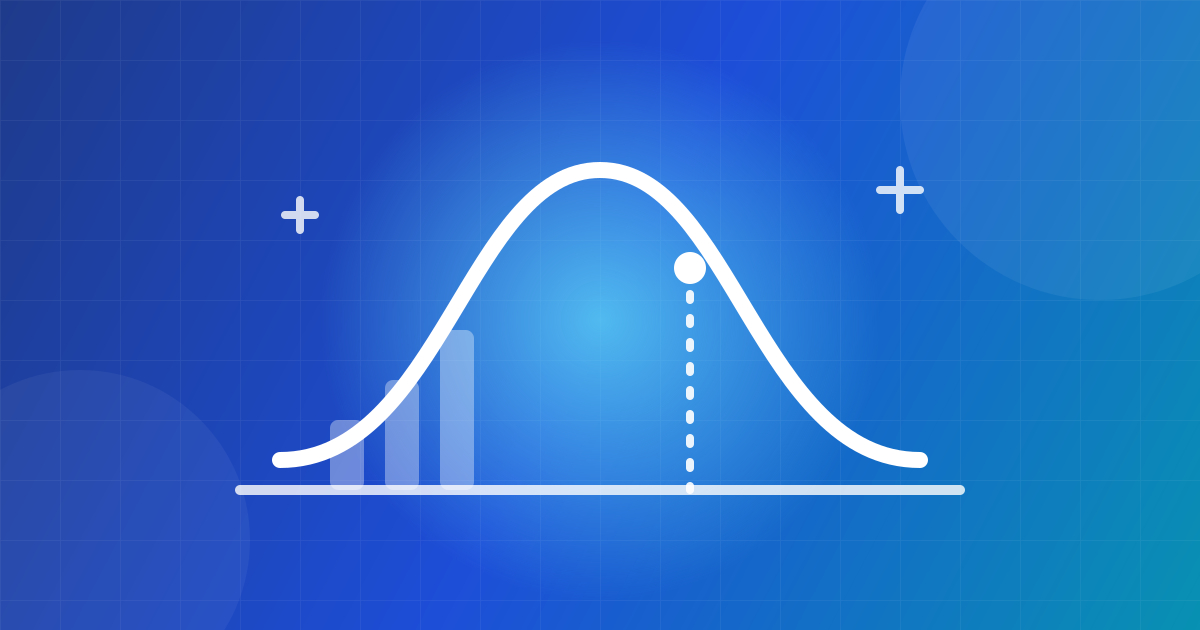
An IQ score range is a band on a scale built by comparing your answers against a large reference group of the same age. The scale is set so the average is 100 and about two thirds of people fall between 85 and 115. A range describes how common a score is, not a fixed amount of intelligence held inside a person.
The number comes from a comparison, not a measurement of a substance. When a test reports 112, it is saying your performance on that test, on that day, sat a bit above the middle of the group the test was normed on.
Ranges exist because a single point is more precise than the test really is. Grouping scores into bands is a way of admitting that 108 and 112 describe roughly the same performance.
What is considered an average IQ score?
An average IQ score is 100. The test is designed and periodically re-normed so that the middle of the reference group always sits at 100. Scores from about 85 to 115 are all treated as within the normal range, and roughly two out of three people score somewhere in that band.
Scoring 100 does not mean you answered every question, or 100 percent of them. It means your raw score placed you near the median of people your age. A different test, or the same test after a poor night's sleep, could move that number several points in either direction.
The table below shows the common bands, the labels test publishers tend to attach to them, and the rough percentile each band covers.
| Score range | Common classification label | Approximate percentile band |
|---|---|---|
| 130 and above | Extremely high, sometimes "gifted" | 98th and above |
| 115 to 129 | Above average, or high average | 84th to 97th |
| 85 to 114 | Average range | 16th to 84th |
| 70 to 84 | Below average, or borderline | 2nd to 16th |
| 69 and below | Extremely low | Below the 2nd |
Different publishers use different words for the same bands. One test's "superior" is another test's "high average". The labels are editorial choices layered on top of the numbers, not scientific categories with hard walls between them. A person who scores 129 and a person who scores 131 are not meaningfully different, even though a table puts them in separate rows.
What does an IQ percentile tell you?
A percentile tells you the share of the reference group that scored at or below you. A percentile of 70 means about 70 percent of people scored the same or lower, and 30 percent scored higher. It is a ranking within a group, not a percentage of questions answered correctly.
Percentiles are not evenly spaced against the score. Near the middle of the scale, a few points of score covers many percentile points, because that is where most people are. Out at the tails, several points of score barely moves the percentile, because almost no one is there.
This is why the same 5-point gap feels different in different places. Going from 100 to 105 moves you from the 50th to about the 63rd percentile. Going from 135 to 140 moves you a fraction of a percentile. For the classification labels that sit on top of these percentiles, see IQ percentile explained.
How accurate is a single IQ score?
A single IQ score is an estimate with a margin of error, usually give or take about 4 to 5 points on a good clinical test and wider on a short online one. The same person can score differently on different days, on different tests, and with more or less sleep. Treat the score as a range, not a point.
Clinical reports often print a confidence interval for this reason, something like "Full Scale IQ 114, 95 percent confidence interval 108 to 119". The single number is the best estimate, and the interval is the honest width around it. A 3 or 4 point difference between two sittings is noise, not change.
A score also captures a narrow slice of ability. It says something about reasoning with patterns, words, and numbers under test conditions. It says nothing about motivation, creativity, judgement, skill, or character, and it does not define anyone's worth or what they can go on to do.
| Source of variation | Typical effect on the score |
|---|---|
| Normal test-to-test error | Around 4 to 5 points either way |
| Poor sleep or high stress | A few points lower |
| Having taken a similar test before | A few points higher on the repeat |
| A different test with different norms | Several points, in either direction |
Do online IQ tests use the same ranges?
Most online tests copy the familiar 100-average, 15-point scale, so the numbers look the same. What differs is the foundation. Online tests are rarely normed on a representative sample, are usually unsupervised, and are often untimed, so the range labels carry far less weight than the same labels on a proctored clinical test.
An untimed test tends to push scores up, because processing speed is part of what a real test measures. An unsupervised test cannot stop someone looking things up. And without a proper norm sample, the percentile attached to your score is a rough guess rather than a calibrated rank.
On this site, the free IQ test with an instant score and percentile reports a number on the same familiar scale, but it is an entertainment estimate. It is not a clinical or validated assessment, and a result from it should not be used for any placement, diagnostic, or hiring decision.
Frequently Asked Questions
Is an IQ of 115 good?
A score of 115 sits about one standard deviation above the average, near the 84th percentile, so it is high in everyday terms. It is also close enough to 100 that ordinary test error could place the same person a little above or below on another day.
What is the highest possible IQ score?
Most modern tests do not report much above 160, because there are too few people at that level to norm the scale reliably. Very high figures quoted online are usually loose estimates or come from tests that use a different scale.
Is a 130 IQ gifted?
Many gifted programmes use 130 as a cutoff because it marks roughly the top 2 percent. The cutoff is an administrative convention. A person at 128 and a person at 132 are not meaningfully different in ability.
Can your IQ score change over time?
Yes. Scores can drift with age, health, education, and practice with test formats. Childhood scores are less stable than adult scores. A single measurement is a snapshot, not a fixed trait.
What does a score below 70 mean?
On a clinical test, a score below about 70 is one input professionals use when assessing intellectual disability, but it is never used alone. Adaptive behaviour and developmental history matter as much as the number, and an online test cannot make this assessment.
Find where your score sits
Our free IQ test covers five reasoning categories and shows your result on the standard scale, with no email required. It is built for curiosity and practice, not diagnosis. For a closer look at how ranking within a group works, read IQ percentile explained.